The two words get used interchangeably on packaging, in shops and in most online advice, which is how people end up pouring the wrong one into a £160 machine. They are different products, made differently, and they behave differently in the air. Here is the honest distinction.
An essential oil is a concentrate pressed or distilled from a single plant: lavender flowers, orange peel, cedar wood. It smells of that one thing, because it is that one thing. Essential oils are wonderful in a bath, in skincare, or in a small ultrasonic diffuser on a bedside table. They are volatile (they evaporate fast), viscous (some are almost syrupy), and they vary from batch to batch depending on the harvest.
A fragrance oil is a composed scent — a perfumer’s formula of dozens of aroma materials, some natural, some made in a lab, blended so that it opens with one impression, settles into another and finishes on a third. It is the same craft that goes into a bottle of eau de parfum, just carried in a base designed for a machine rather than for skin. Fragrance oils are consistent, stable, and formulated to atomise into a fine dry mist without separating or clogging.
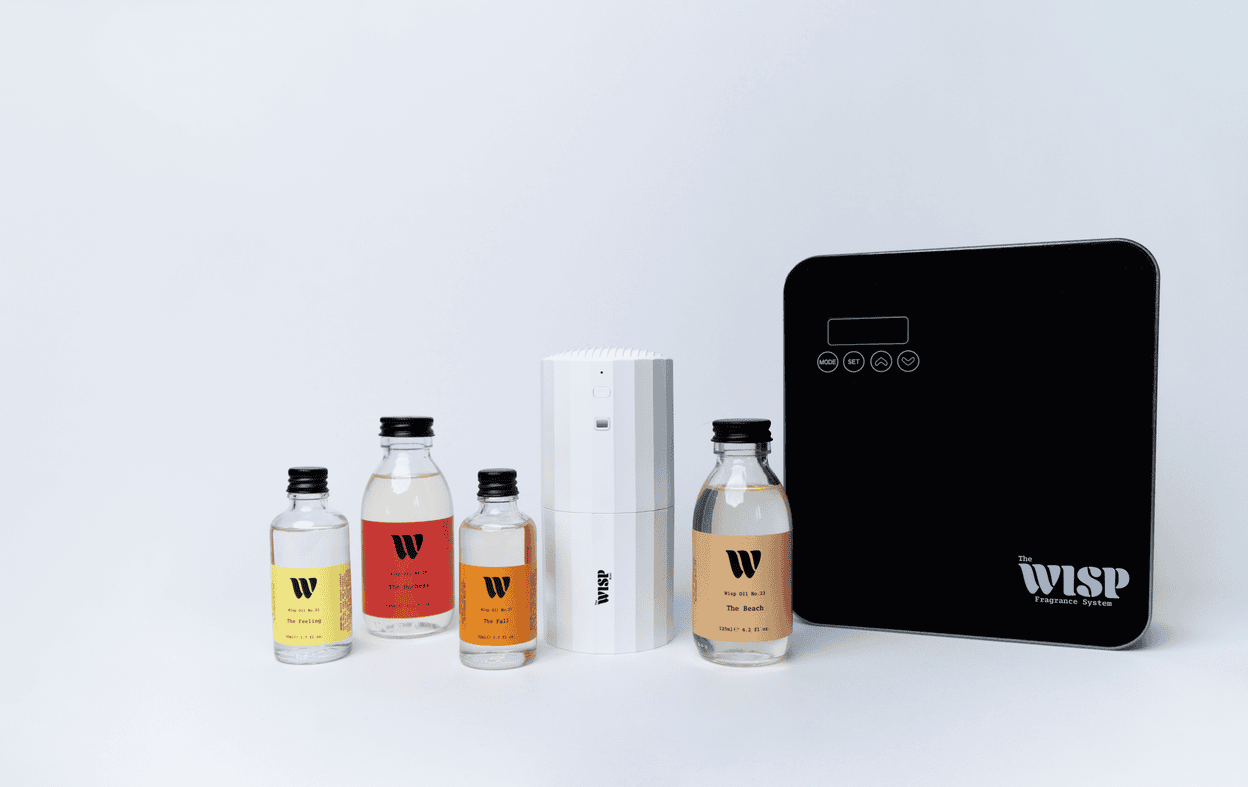
Every Wisp fragrance oil is a fragrance oil in this sense. The Wisp No.1, for instance, opens on bergamot and peach, moves into watermelon and closes on coconut and chocolate. No single plant does that.
| Essential oil | Fragrance oil | |
|---|---|---|
| What it is | Single-plant extract | Composed perfume formula |
| Scent | One note, literal | Top, heart and base notes that develop |
| Consistency | Varies by harvest | Identical bottle to bottle |
| In a cold-air diffuser | Too thick or too volatile; can block the nozzle | Designed for it |
| Room coverage | Small, close to the device | Whole room with the right machine |
| Cost per hour of scent | High (neat oils are dear) | Low (a 10 ml bottle runs many evenings) |
A cold-air diffuser draws oil up a narrow channel and shears it into particles a few microns wide. That only works within a fairly tight range of viscosity and volatility. Fragrance oils for diffusers are made to sit inside that range. Neat essential oils sit outside it in both directions — citrus oils flash off and give you ten minutes of scent, resinous oils gum the nozzle. Candle fragrance and reed diffuser liquid are wrong for a different reason: they are carried in solvents meant to evaporate slowly from a wick or reed, not to be atomised.
The practical rule is simple: use the oil the machine was built for. Both Wisp machines are tested with Wisp oils, and the nozzles are sized for them.
Natural and synthetic are not the same axis as safe and unsafe. Plenty of essential oils are skin sensitisers or are unsafe around cats; plenty of lab-made aroma materials are the gentlest things in the bottle. What matters is that the finished fragrance is assessed under IFRA guidelines and labelled properly, which is the standard we work to. If you want a scent that smells of one specific plant and nothing else, an essential oil is the honest choice. If you want a room to smell like a place — a hotel lobby, a linen cupboard, a leather chair by a fire — you want a composed fragrance.
For a cold-air or plug-in atomising diffuser, use fragrance oil. For a small ultrasonic water diffuser, a bath or a pillow spray, essential oils are fine. If you are not sure which of our 31 fragrances suits the room you have in mind, the Fragrance Finder will narrow it down in a minute.
It is not recommended. Neat essential oils are either too volatile (citrus, mint) or too thick (resins, sandalwood) to atomise cleanly, and they can block the nozzle. Cold-air machines are built for fragrance oil formulated to the right viscosity.
Fragrance oils used in properly made diffusers are assessed against IFRA safety standards and used at low concentrations in the air. As with any fragrance, ventilate normally, start with shorter run times, and keep machines away from children and pets.
Yes. A composed fragrance oil is built with base notes that anchor it, so it stays present in a room for hours. Most essential oils are top-note heavy and disappear quickly, particularly citrus.
No. Wisp oils are composed fragrance oils — perfume-style formulas with top, heart and base notes — designed for cold-air diffusion. They are hand-bottled in Nottingham in 10 ml, 50 ml and 125 ml sizes.

